as in engines

“Blackout at the terror trials
It’s the sixth year of their wars
I’m pacing shotgun hallways
While my fucking neighbour snores”
- A Silver Mt Zion (2008)
As part of its definition of “direct,” the Oxford English Dictionary gives for the adjective: “Effected or existing without intermediation or intervening agency; immediate.” When modifying a mechanical action – as in engines, for example – the word applies to that which “takes effect without intermediate instrumentality"; used to describe a mode of expression, it suggests something carried out “In a straightforward manner; clearly; in a frank or honest manner; candidly.” Though I think we should be wary of the temptation to evaluate materially effective action within the same critical register as one might a speech act – though, of course, where we locate that porous border between the former and the latter is a whole other discussion – it’s worthwhile to keep these different inflections of meaning in mind if we’re going to keep having all these conversations about “direct action” (and I sincerely hope we are).
There are, of course, plenty of definitions to be had. The OED’s is really impossibly broad: “The exertion of pressure on the community through any action which is directly effective, such as strikes, sabotage, or demonstrations, as distinguished from action through constitutional processes.” Thee David Graeber, on the other hand, takes a more high-minded and lyrical swing, embedding some of his and his contemporaries’ thinking around pre-figuration: “It is a form of action in which means and ends become, effectively, indistinguishable…At its most elaborate, the structure of one's own act becomes a kind of micro-utopia, a concrete model for one's vision of a free society.” That’s a lovely one, of course, but how often has that really felt like the case when you’re getting pushed around by police in the snow?
My own understanding of the idea was first formed around the turn of millennium, approaching the end of my teen years in the wake of the protests in Seattle and Quebec City (though the closest I ever actually got to them was an anti-FTAA demo at the border crossing south of Vancouver). I drank in all of that big-tent anarchist discourse about diversity of tactics, laced with the disdain for both electoral politics and for putative “non-violence” which now colours all my thinking on the subject. I learned about the Wobblies, notably, courtesy of Ani DiFranco and Utah Phillips (“They broke the jail!”), and then it was Ward Churchill and Peter Gelderloos, Graeber and Anne Hansen and a million random zines. Like many of us, I think, I’ve spent most of my life believing that we ought to act in immediate ways on local scales, seeking tangible results, and that doing so would register some sort of effect on the broader systems that form the foundations of the whole social structure (or at least build our collective capacity to do so at some point in the future). It’s a faith I still do my best to cling to, exhausting as it all sometimes feels these days.
Humans have obviously been engaging in actions we would rightly call “direct” since time immemorial, but “direct action,” as a term, has a history. And its appearance as such – around the start of the twentieth century, by most accounts – suggests a point at which it had become necessary to express opposition to some other mode of action, an emergent desire to differentiate from some generalized indirectness which would otherwise have been the default. That’s modernity, I guess, and one of the great affects of bourgeois democracy: the feeling that sparks in your heart as you’re offered ostensible routes towards power which you know lead nowhere (RIP Lauren Berlant).
If people like us – "we," if you like – have learned to live with the fact that we’re implicated in circuits of astonishing violence which we aren’t often required to acknowledge, it’s because our connections to them run through a thicket of intermediaries: the cash registers and gas pumps and YouTube channels as well as the bosses and cops and venture capitalists. (And one of the particular burns of this hyperreal era of social media, of course, is the vertigo of feeling more connected to the most extreme horrors than ever before while simultaneously further away from them – as the last, say, two years and nearly three months have made abundantly clear.) There’s no direct line to the real source of our enemies’ power, no central mainframes we can hack, but an endless diffusion of responsibility running all the way down, an eternal picking of battles as we try to sate that overwhelming craving for something decisive to do with our hands.
So directness is something that can only really be measured relatively: there’s no line that distinguishes the purely direct actions from the indirect ones. It’s always a striving to overcome those inertias that push us towards compromise and away from conflict, towards what’s practiced and away from what’s uncomfortable. And so it is with all of our actions, really: we do our best militate towards humility and generosity and integrity, uphill though it may often feel in so corrupted a political culture as this one. And so I’m not particularly interested in elaborating a taxonomy of what does or doesn’t count as a bona fide “DA” – that ought to be a fairly straightforward task anyways: you’ve just got to ask what’s being acted upon – but I’m interested in thinking through its aspirational content, what we’re after when we use the expression at all, and maybe, how we can make it more ambitious.
And as indicated above, to be direct also means to be honest. So as 2025 draws to a close, one thing I’ll say for myself is that I’m aspiring to be more direct and more honest. I’d like to stop letting impulses I’m not proud of motivate so many of my actions. I’d like to stop letting so many words I don’t believe in leave my mouth. And for what it's worth I'd also like to extend my genuine gratitude to those fellow travellers who have led by example and helped keep me on track this year.
Anyways, god bless anyone who’s doing anything, and see you soon.
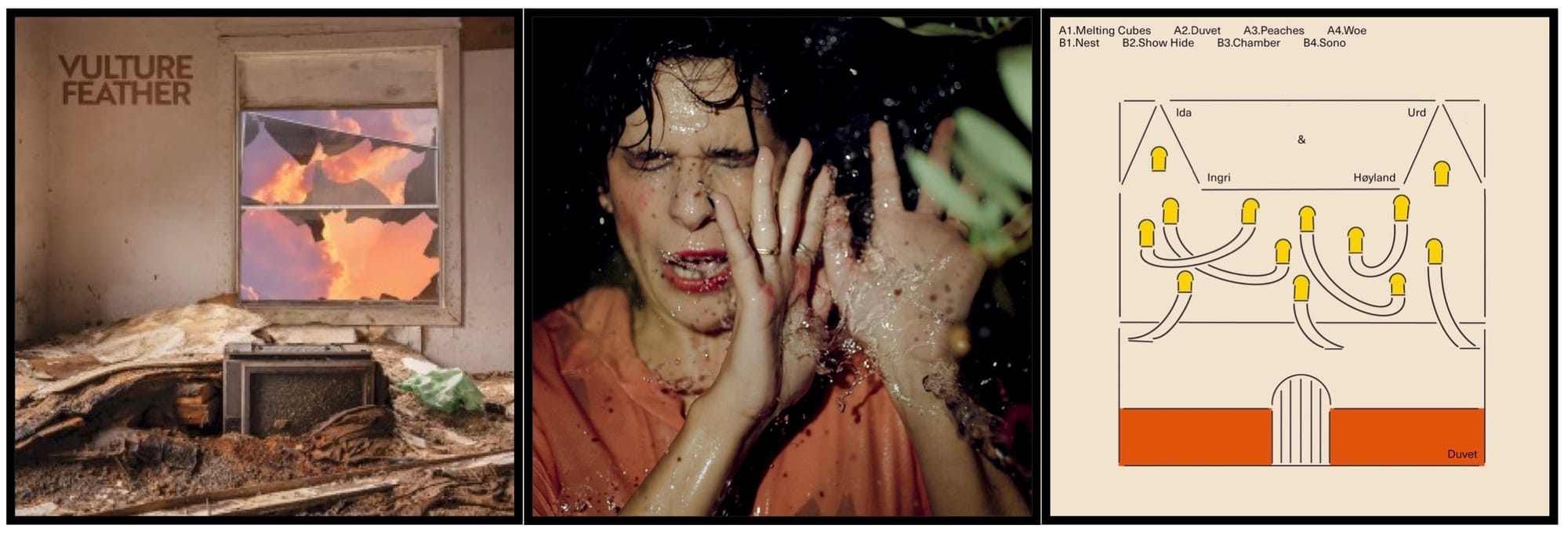
Just real quick, since it's the end of the year, here are three of my favourite records of 2025 (in no particular order):
Vulture Feather - It Will Be Like Now (via Felte, February)
Life-affirming minimalist post-punk from Northern California with roots in 90s emocore (members of Don Martin Three!!). Heartfelt and earnest but never cloying, driving and passionate but never overwrought.
Postcards - Ripe (via Ruptured, March)
A ferocious and acerbic blast of gritty post-punk from the longstanding Beirut trio, animated by the grief and rage of living through our dystopian present. Blonde Redhead meets the Wipers, maybe?
Ida Urd & Ingri Høyland - Duvet (via Balmat, September)
Gestural yet ornately textured, emotionally engaging ambient soundscapes from the Danish/Norwegian duo. It’s dreamy and serene but far from a passive listen, punctuated as it is with subtle tension and an exploratory drive.
Okay, so there's really been an embarrassment of riches in terms of new ambient-experimental music coming out around October and November this year, and the mix this time just scratches the surface. Throw this on and get working on those resolutions, yeah?
First it's "Rionnag a Tuath," pulled from Scottish composer Claire M. Singer's latest LP, Gleann Ciùin, a suite of gorgeous melodic drones worked up primarily from pipe organs, which came out in November. Next, Australian producer Peter Knight's "Leaf and Shadow" rolls in like an early morning rain cloud, a slow-moving haze of spacious synth drone laced with spectral calls from the trumpet. That's from For a Moment the Sky Knew My Name, also released in November. Then it's Brooklyn's C. Lavender, who her harnessed her latest work creating immersive and meditative soundscape installations to release Convex Umbra in October. Opener "Intercellular Relay" (featuring Anthony Childs), feels at once obscure and radiant, static and dizzying.
After this it's "Sonido Dueñez," from Debit – Mexican-American producer Delia Beatriz, currently based in New York – whose stunning Desaceleradas LP released in November. Alongside the creation of her more club-ready work, Beatriz has spent the last few years immersed in the tradition of cumbia rebajada, which issues from her hometown of Monterrey and essentially proposes drastically slowed-down takes on Colombian cumbia. For Desacelerados, she drew on the archives of Gabriel Dueñez, a pioneer of the micro-genre, to produce a glitchy, shimmering, minutely-detailed remediation of the original material, shot through with generations of sedimented meaning. "Much more than just an academic exercise of slowing material down to its lowest possible bpm," noted Ammar Kalia for The Guardian, "Beatriz’s arrangements force us to focus on the innate strangeness of the present moment."
Next it's LA dronesmith Yann Novak, with the patient, penumbral drift of "Context Collapse," from July's Continuity, followed by German duo Guentner Spieth, with "Vortex," a warm and highly saturated pulse of ambient electronics with a hypnotic metronome heartbeat; their Conversion LP has become a staple of my early-morning listening since its release in October. Then it's Paris-based sound sculptor Georges Daou, whose Blue Ghost LP also came out in October. "Bitter Truth" comes in waves of nostalgia and mournful reflection, its haunting choral opening giving way to a tableau of field recordings atop a quietly unsettling drone. After that, it's Beirut's Yara Asmar and "wooden giants and mechanical birds," which features guest musicians John Murchison and Gideon Forbes, drawn from October's everyone I love is sleeping and I love them so so much. The impressionistic track lands somewhere between ambient drone and free-form jazz, its richly resonant opening chimes quickly joined by grainy strings, saxophone and plucked double bass.
Nearing the close, Copenhagen-based bassist Thomas Morgan is joined by guitar hero Bill Frisell for "Rising From the West," from Morgan's Around You Is A Forest, a thrilling collection of duets released in November. And finally, it's New England ambient Americana ensemble Old Saw with "Aproxmare," drawn from October's The Wringing Cloth LP: all sunset, fingers on strings and swells of reverberating vibrato. And that's it!
• Mixcloud: as in engines (dec 2025)
• MP3s: 25/12 - as in engines.zip
NB: The zip file linked above contains the individual MP3s as well as a single hour-long track of the whole mix.
Finally, if you'll allow me, I thought I'd include a little roundup of the music writing I put out this year. As you'll perhaps note, I'm still sorting out how to do this thing – and for real, fire away if you've got any feedback! – but it's really been a privilege to get to spend time thinking with/about such incredible work, and I'm feeling pretty grateful for the opportunity. Anyways here it is:
• Interview/profile: "Wood, Wire, and Willpower: BIG | BRAVE Patch the Circuit" (30 April, New Feeling)
• Album review: anthéne, frailty (5 May, A Closer Listen)
• Album review: Theresa Wong, Journey to the Cave of Guanyin (31 May, A Closer Listen)
• Album review: Clare O'Connell, Light Flowing (20 Sept, A Closer Listen)
• Album review: PRAED Orchestra, The Dictionary of Lost Meanings (1 Nov, A Closer Listen)
• Interview/profile: "'The process is the project' : Egyptian Cotton Arkestra stays rooted in Time and Place" (28 Nov, New Feeling)
Phew, okay that's it! Thanks for reading, everyone, and thanks especially to KP for editorial support, LH for tech consulting, and DB for design and tech support. Don't be strangers, friends.
xo, graham
PS. Montrealers!! Come see Tempête Solaire – "apocalyptic party music" from Elyze Venne-Deshaies and Erics Quach and Craven – launch their new tape, Le précession des équinoxes, at P'Tit Ours on Tuesday, Dec 30! (tickets here)